“You can win this, you know!' #
A Peterhouse rowing story #
told from the inboard ends of many oars. #
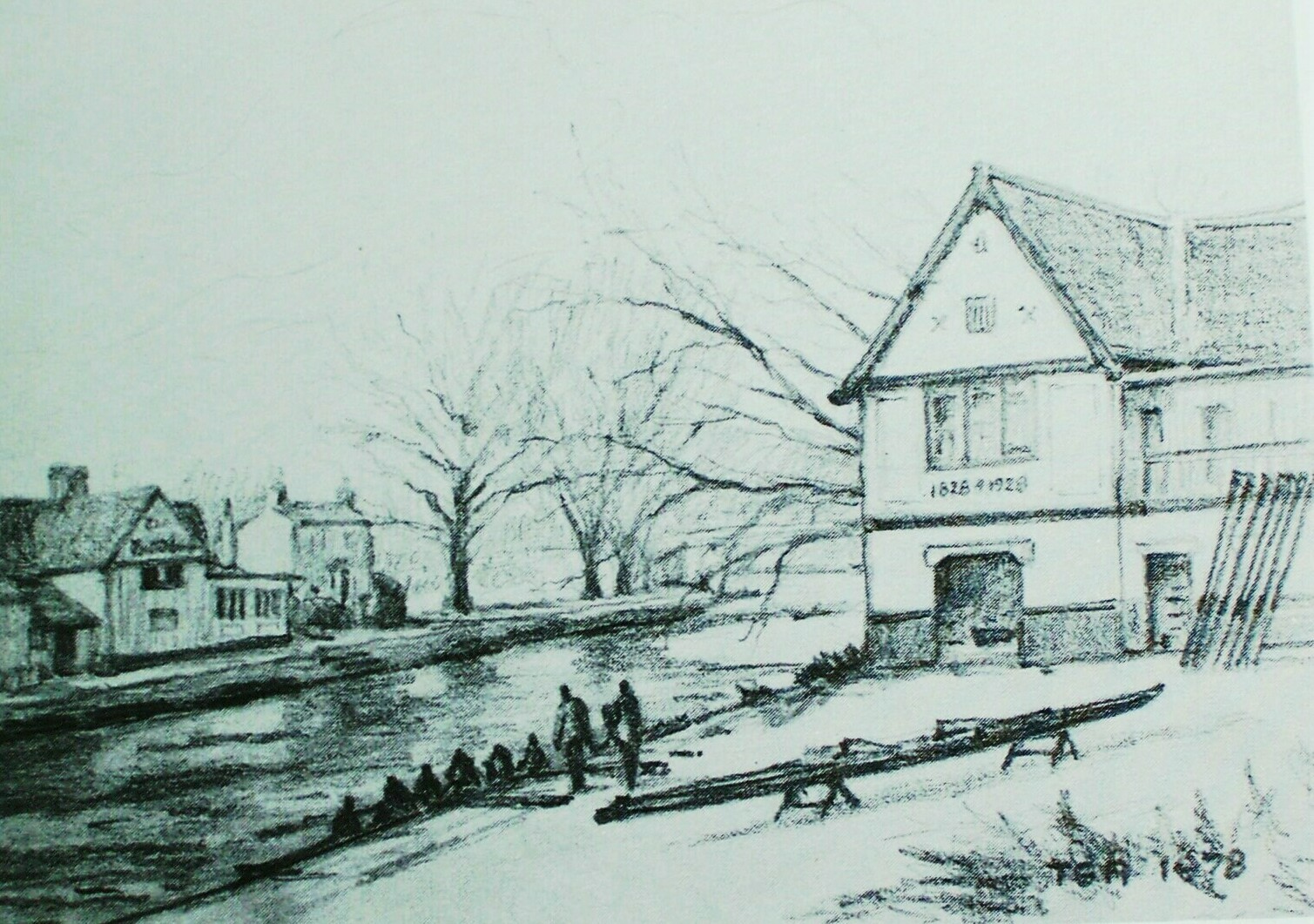
Our beloved boathouse, sketched by Tom Askwith #
50 years after it was built
… with thanks to all who went before,
… for all who may follow*.***
March 2006 #
“You can win this, you know!” #
Those six words, quietly spoken by Ernie Lingwood as he pushed us out for the Fairbairn, were hugely significant.
Ernie didn’t coach, but he’d sent our boats and our blue and white blades into action for approaching thirty years. His vote of confidence was perfectly timed to inspire us.
The Fairbairn start was above our own Peterhouse footbridge. Gordon took us off at an outrageous rating, enthusiastically supported. (It was clocked at 44.) We were up to 1st and 3rd’s rudder by the Gasworks. Their cox ceded to David and gave us the bend at Chesterton. We were driving past them by the Pike and Eel.
That morale booster carried us down Long Reach and round the corners with only four crews in front of us. We didn’t have much left approaching Baitsbite.
At the finish, the recorder was writing times on the list of crews, in starting order, when someone tapped him on the shoulder and said “That wasn’t 1st and 3rd!”
Ernie was right, bless him, – we’d won.
Peterhouse 16:03
Jesus 16:10
L.M.B.C. 16:15
The scarf around the neck of Steve Fairbairn’s bust in Jesus, acquired a scrap of Peterhouse blue that evening.
Why were Ernie’s few words so significant, and how did the tiniest of our colleges manage to pull this off?
That’s our story.
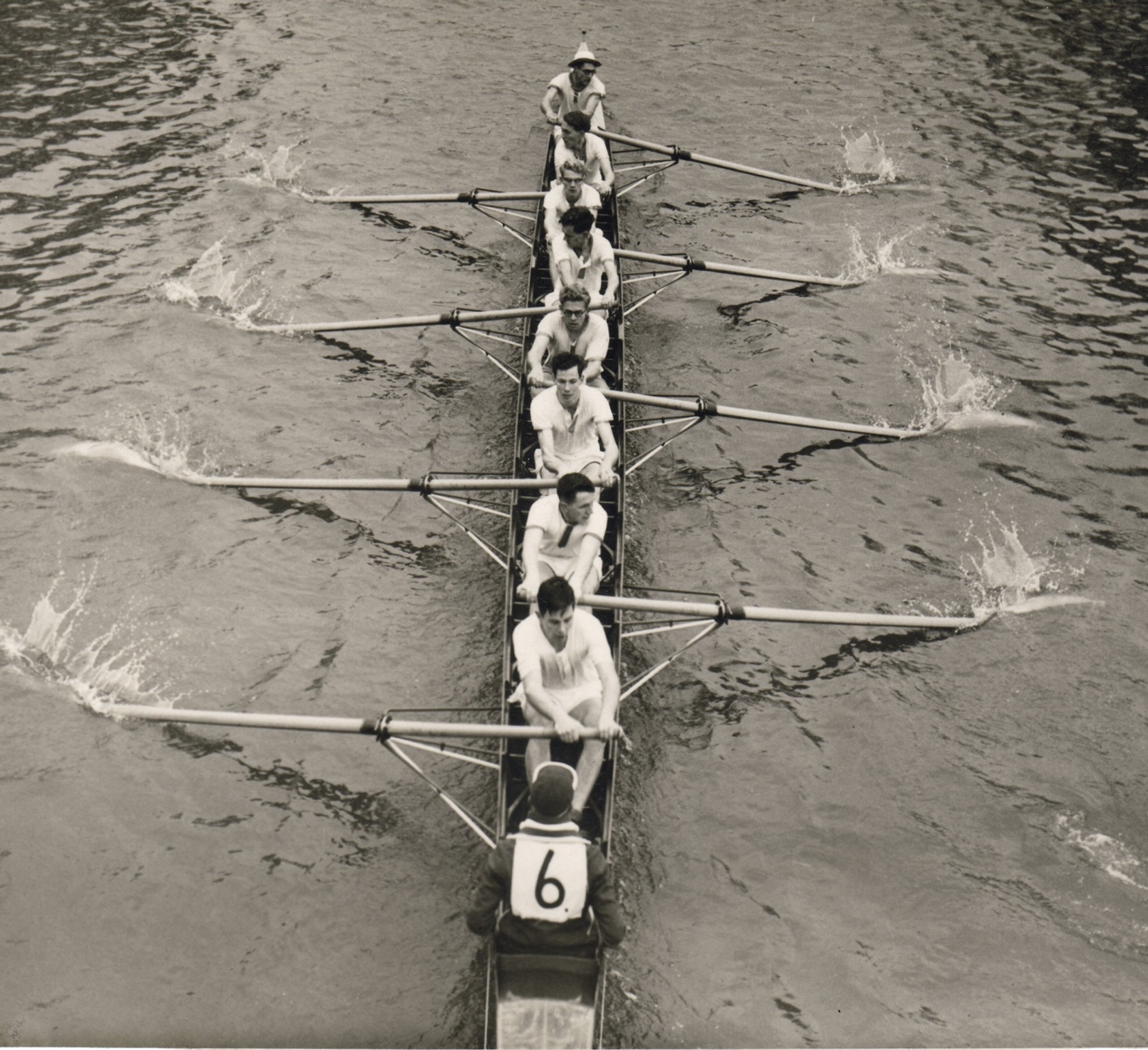
The ‘55 Fairbairn crew off to a good start … already well past their puddles.
Gordon Hewlett Str., Bill Gear, Brian Oxley, Mike Smith, Ted Jackson,
Robert van Hoeken, Ian Dodds and David Harper. Cox – D.M.F.Bright.
The knowing eye may detect variously individual approaches to the oar.
Lady Margaret would have wept in her beer, but Steve would have applauded; his credo was simple: “Move the boat!”
Eventually the Times would describe us as “a rough crew, but fast!”
How fast? … First let’s go back a few years.
Roland Mayer and Tim Ambrose gave us “A short account of the Peterhouse Boat Club.” (1978) Behind that wonderfully readable but necessarily condensed history, lie untold evocative tales. Unless recorded, they will be lost to us.
Our 1920 Captain set the scene when he gave us
----------------------------------------------------
A Few Notes for Future
P.B.C. Captains
BY
W. G. HERTEN,
Captain, 1920-21.
___________
I am writing these notes for the following reasons: The P.B.C. has put up some good shows in the past, but it has also put up some jolly bad ones, and unfortunately, at the time of writing, the latter outweigh the former. I attribute this to two things:-
I. – Lack of interest
II. – Bad captaining and coaching.
The former is the natural outcome of the latter. The second is due to many causes. Inexperience, slackness, no ambition and not knowing what to do, and it is because of this last reason that I am writing.
To start out, you may have heard people say: “Peterhouse is not a rowing college and never will be, we’ll never do any good on the river, etc. etc.” The answer to that is “ROT.” In 1842 we were Head of the River. This is a goodish while back, but it doesn’t matter; there are only six colleges out of about 19 or 20 who can say that. Then you only need to go into the “Sex” and look at the oars there. ….
Herten didn’t pull any punches! His long essay evokes the 20’s. He set out all that should be done in the course of a year, including “A revolver is useful for giving ten, as a coach is seldom heard during the race.”
He also said “Up to the present, Peterhouse have never been to Henley, but I hope that happy day is not too far off. Though nothing may be won, the presence of critical grey-headed old men on the bank, wearing light and dark blue caps, makes one row one’s very best, and a light ship and the Henley water teach one a great deal.”
------------------------------------------------------------------------
Herten died in 1931, but his father created a fund to help Peterhouse go to Henley.
His personal drive was part of an upwards surge. Membership increased . Pothouse learnt how to win. Our boathouse was built. Crews enjoyed their rowing and Tom Askwith won the Colqhouns and much else. Roland Mayer’s “short account” tells of a glowing period. Captains from those years later kept in touch with PBC. Biddulph appeared on the bank. Nick Kaye sparked our boat fund, and of course Tom became our very own inspiration to “make one row one’s very best.”
Fast forward to post WWII.
General Sir Hugh Beach (‘41) returned in 1946 to complete his degree In our last “Peterhouse,” he reported that “I shared rooms with my great friend Marston Tickell, who served with me in the Sappers and rose to become a Major General. I became Captain of Boats … “ (and so in his turn did Marston Tickell.)
Hugh describes those days vividly, and one knows they are still fresh in his mind:
“We were half and half those straight from school, and those returning from war service. We mixed very well. The club was run by third year boys. We buckled in and did what we were told. Ogilvy was Captain; he went on to become a doctor.
‘47 was that very cold year. The river narrowed as the ice grew out from the banks. I was at bow and the snow used to build up on my back!
Much to my surprise, I was asked to be Captain. I was only 10 st., so I switched to cox and could do a bit of coaching from there. Fortunately, I found an excellent coach in Noel Duckworth who had been a blue. Noel had been a Japanese p.o.w. I think he worked on the Burma/Siam railway, but he never spoke of it. Although much damaged, he returned to become the chaplain of St.Johns. He was very firmly a Fairbairn man – “chumph” and bell notes. We didn’t win anything, so I suppose we were the trough!”
Bob Elphick, Capt. 51/52, comments that “During that time, there was as I understand it a big dispute within the club as to the merits of various rowing styles. At one point, the first eight, who were said to prefer looking elegant to actually moving the boat fast, was consistently slower than the second boat. The second boat, with coaches from Jesus had taken up the Fairbairn bellnote style. This latter style was certainly in vogue in my time.” Our charts show the 1st boat dropping in 47/48, while 2nd and 3rd boats shot up.
So there you see it – the Fairbairn approach. Duckworth, Hugh Beach’s appointee, was a Jesus man, in the winning blue boats of 34, 35 and 36. So … hard work, mileage and “chumph!”
One has only to look at the Lent bumps records to see how the club then progressed:
Bumped Jesus 3
Bumped Downing, Selwyn and Maggie 2 on day 3, and Magdalene on day 4
Bumped Queens’, Christ’s and Caius
Bumped St Catherine’s, Jesus 2, Emma and Trinity Hall
Bumped Corpus Christi
Bumped Clare and Pembroke
That brought us up to fourth – striking distance of the top. We had to finish the job!
Captains in those years were: Marston Tickell (48/49); Maurice Temple Smith(49/50); Alan Quilter (50/51); Robert Elphick (51/52); Michael Rodd (52/53); Paul Hewlett (53/54); and Howard Leach (54/55)
Bob Elphick, never bumped during three years in the 1st boat, also reports:
“We used to go out every afternoon, Monday to Saturday. On Sundays Alan Quilter got us out on a long run across the fen and along the river up to Grantchester Church and back to the College for a proper big breakfast. It was also in Quilter’s reign that we bought from the post office a large telegraph pole. On most mornings he had us out early in the deer park heaving the thing around to build up muscle power and timing. I carried on the tradition. The pole was, I’m told, later laid to rest somewhere near the water gate. We tried to find it many years later, but there was no trace even of a splinter.
*As for training, so called, we used to give up smoking and booze for
just the fortnight before the races. The Masters of my time, Paul
Vellacott and later Herbert Butterfield, used to be great supporters of
the boat club. They both in their turn entertained the first eight to
breakfast in the parlour each year on the Saturday before the Mays. The
menu, despite the continuing wartime rationing, was always scrambled
eggs and smoked salmon, buttered toast, marmalade. Champagne was served
throughout the meal to wash it all down. We marked the event properly by
turning up in our whites with blazers and ties.
*
We always attended the Reading and Tideway Head of the
River races, rowing down the Thames from Reading every year, taking
three
days to get to Putney. There's a lock with a pub about every three
miles. We
used to lodge the boat at Thames RC and get Ernie down to service it.
We won the Clinker pennant in 1950, when we started 144th and
finished 15th overall, in 19:45 which was a remarkable achievement
considering we had lost a good bit of the ebb tide. I still remember it
as one of the best rows ever
experienced.
*We went to Henley each year I was there, not doing very well. Our
landlady, Rachel O'Malley had a spacious flat at 10 Royal Mansions near
the
railway station. We slept half a dozen to the room and she fed us
splendidly
altho she was a bit scathing about our lack of success.
*
I note in looking thru my pix that in the Fairbairn eights in 1951
we finished 3rd. Jesus won as usual and we were only one second behind
1st
and 3rd. Our bowman was Max Pennington. I wouldn't let him cox any
more
because he'd beaten me in the college sculls the previous summer.
Heigh-ho.
Best regards Bob”
{Ed. I met Rachel but once. She had a grand piano and on it were her violin and a copy of the fiercely difficult Wieniawski concerto. Must have been quite a gal! B.}
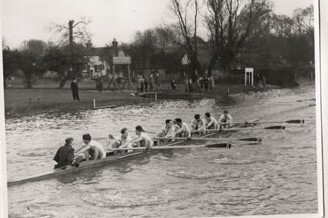
Bob provided this photo of the ‘51 Lents crew which took us back into the 1st division.
Good reach and stride, - and well-balanced. A competent crew, for sure!
… and below, also from Bob - of the 1951 Mays crew in more formal pose:
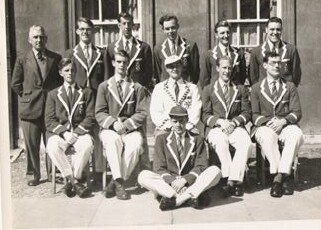
“Ernie Lingwood, Gareth Slater, John Cox, Roger Beresford, Bob Elphick, Ken Shield.
Front row: Alan Quilter, Maurice Temple Smith, Con Rainbow (Jesus), John Hardy, John Smallwood. Max Pennington in front .We made two bumps.
Temple Smith, Alan Quilter and I were successive Captains of Boats. Maurice Temple-Smith took time out of the boat that term to do some coaching and get a 1st in English.
………………………………………………….
That sets our scene. Now I can only attempt to amuse while telling the story into which I was drawn by accident, and provide recollections from within the boat.
Freshly returned from a remote tropical country, I was encouraged by my good school-friend Paul Hewlett to take up rowing. Little did I know what lay ahead!
My first memories are of the 2nd boat in the ‘53 Fairbairn.
Bow man was another innocent abroad – Chris Calladine.
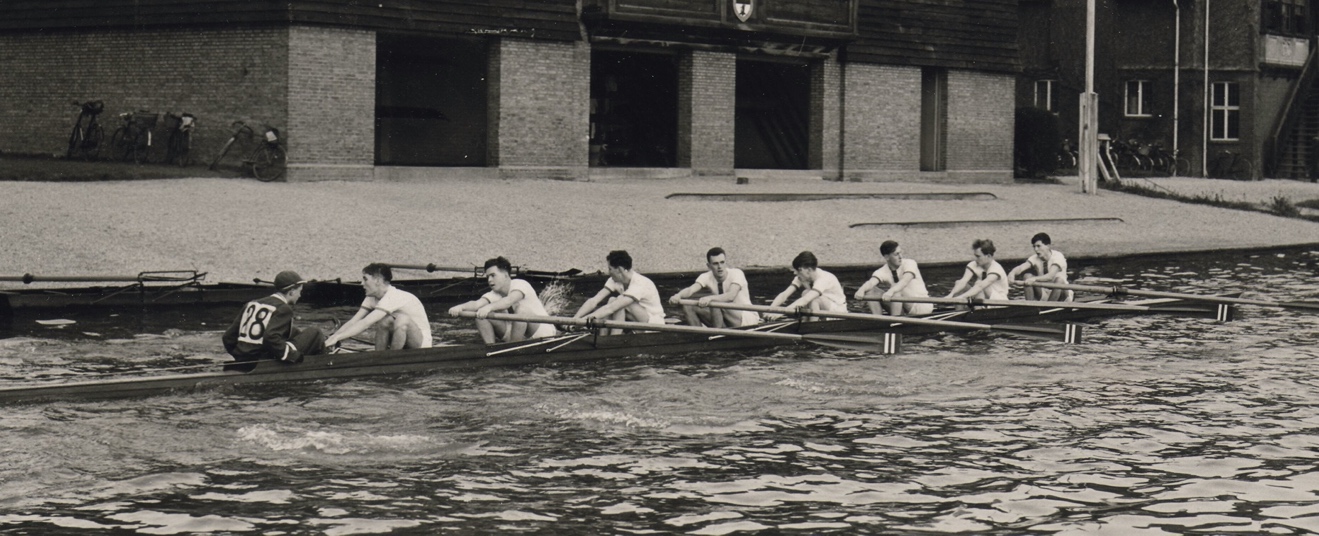
Cox Martin. Crew: Toulman, Wilson-Smith, Oxley, Poolman, Longley, Lord, Calladine.
(I wonder whether bow side found the water in time for the next stroke!)
The party after that Fairbairn was interesting. It was given by our College chaplain Brian Wormald in his rooms. He had been cox in his day. The featured drink was a fruit punch. What we didn’t realise was that Wormald kept it well stoked with gin. The next morning I had to attend an obligatory rifle practice at the Barton range, which I see is still there, apparently unchanged. I duly set off by bike from my digs in Little St. Mary’s Lane. It was some time before my right foot caught up with the pedal. That fruit punch was memorable!
The Lent term saw me trying to get to grips with Maths, Physics and Chemistry, so I opted for the less demanding schedule of the 3rd boat. So did the man who would be Captain the following year - Howard Leach. Less demanding? We rowed seven full-course races in the four days of those Lents and learnt all about exhaustion. While we were struggling in the basement, the 1st boat continued to rise, bumping Corpus Christi. At the end of term, a trip to the Reading Head in the 1st boat was an honour indeed! That crew contained Martin (cox), Paul Hewlett at stroke, plus Burn, Oxley, Leach, Newth, Gear, Davis and Hood.
The summer term saw our newly acquired Fellow-Commoner, one Danny Taylor, step into a boat. The May boat of ‘54 was Martin (cox), Hewlett (str), plus Leach, Sutherby, Taylor, Oxley, Burn, Davis and J.R.Bartlett. Coach was C.W. Scott of Jesus, who was known to read Fairbairn in quiet moments in his digs.
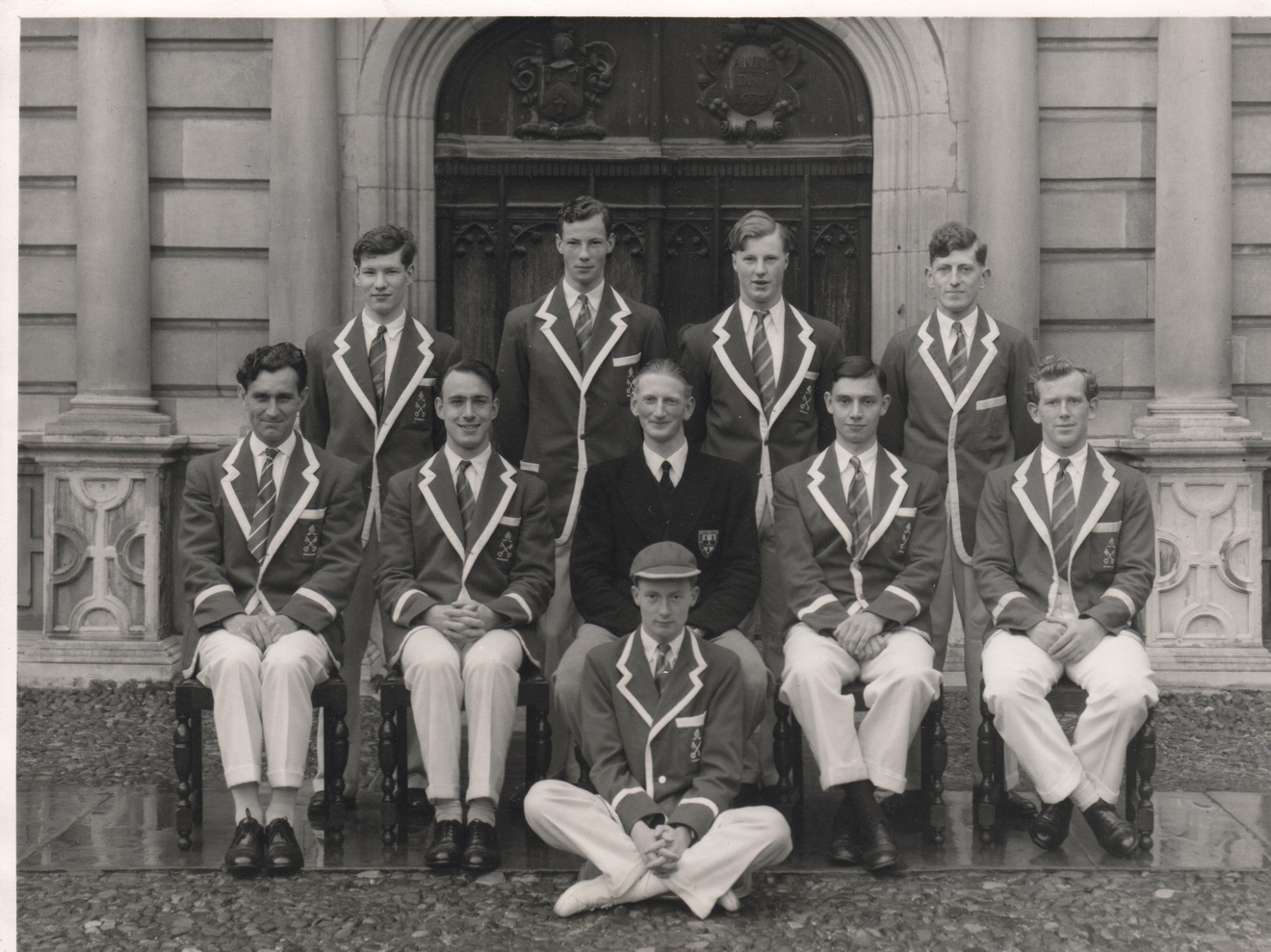 Mays, ‘54 Bartlett, Oxley, Burn, Davis
Taylor, Leach, Scott, Hewlett, Sutherby
Martin
Henley that year was notable; Krylia Sovietov arrived on the scene. This was Russia’s first appearance in the rowing world, using a boat removed from Germany at the end of the war. Their stroke was a remarkable man, head and shoulders taller than the rest of the crew. The oar looked like a toothpick in his hands. They wore sleeveless singlets – a first at Henley, which revealed rippling bronzed muscles. Also, it seemed to us that they may have read standard texts on rowing and said to themselves “this is capitalist nonsense, so we will do it in quite an opposite way.” No hands-away recovery to a gather for a spring - oh no – sit there at the finish, with all the weight in the bows, then dash forward at the last moment to grab a new beginning with a quick flick of wrist and forearm. Remarkably, it worked. They were unbeatable. So strong! They could also be seen wandering around town, gazing in amazement into shop windows. Welcome to the rest of the world, we thought!
A veil should be drawn over Peterhouse’s brief appearance. We were a fairly solid crew, but our strategy against King’s London failed. We had picked a point down the course where, if we were in the lead we would give it ten to get away; if level we would give it ten to take the lead; and if trailing we would give it ten to catch up. The moment came, we were in the lead, we gave it ten, and Kings’ rowed past us while we were thus pre-occupied. The experience, though humbling, taught us … well I’m not sure what!
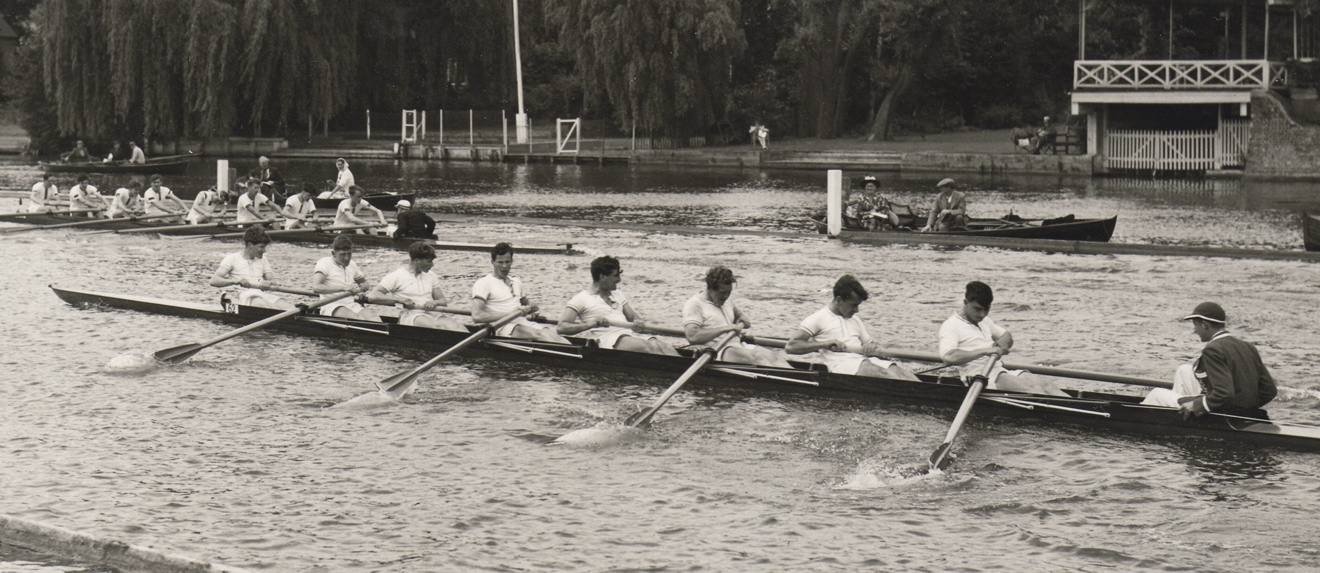
Henley, ‘54 John Bartlett, John Davis, Bob Burn, Brian Oxley, Danny Taylor, Peter Sutherby, Howard Leach, Paul Hewlett str., Richard Martin cox.
But above all, Henley drives the rowing virus deeper into one’s system, so the survivors from the summer of ‘54 set about the new year with a will. Howard Leach became Captain. He and I swapped sides, which put Howard at stroke and me at 7 – a salutary experience when you’re used to looking the other way to see what your blade is up to. Danny thought it might improve oarsmanship. (Eventually it did, but it was well into the Lent term before I suddenly rowed a stroke I recognized as being wholly satisfying. Thereafter I was like the novice golfer who blasts his ball down the middle of the fairway and then has to work out how the heck he did that!) With us were Paul Metcalf at 6, Mike Smith at 5, Ian Dodds at 4, Geoff Poolman at 3, Bill Gear at 2 and Mike Herten at bow. Our cox was now Christopher Phelps, a fine mathematician and also a man with a determined voice and a keen eye for a good course. Without knowing it, we had brought together much of the core of the ‘56 gang. We came 5th = with 1st and 3rd in 15:55.
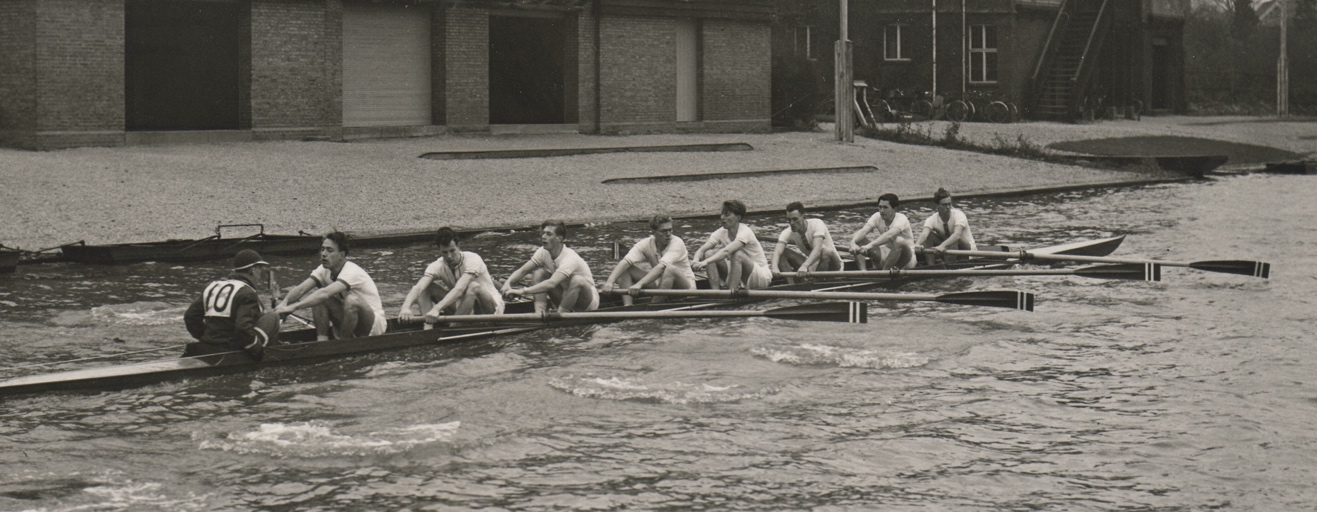
Faribairn ‘54 Phelps, Leach, Oxley, Metcalf, Smith, Dodds, Poolman, Gear, M.Herten.
We had a new boat for the Lents – the John Cosin. Those were the days when boats were named after long-departed Petreans who could neither object, nor be summoned to the river in doubtful weather for a launching! Hugo de Balsham still held our affections though, having made so many bumps in his illustrious career. Can see him now – varnish so well tended by Ernie.
By now, we had picked up a thing or two from Danny and the boat was going well. So well that we were able to bump Clare and Pembroke, to reach our highest standing since 1882. The Pembroke bump was a hoot. They hadn’t acknowledged and had escaped. When we caught up with them again the next day in Long Reach, we weren’t going to stop until we really had them. Riding up over their stroke’s rigger, David Longley looked down on their Captain and commented “Nearly got your boat this time, Stanfield!” Maybe that was the day Danny came off his bike. All I can remember is being at 7 with a good view of the bank and seeing Danny’s head emerge at river level through a crowd of legs, still bellowing exhortations.
Mind you, that wasn’t the first time Danny had come off his bike. Once there was a goat munching quietly beside the river when Danny rode by wearing his green cap, smoking a cigarette through his megaphone and issuing instructions the while (I used to know a clarinet player who could play and talk back at the conductor at the same time – perhaps a related skill). The goat moved. It was tethered by a chain to the other side of the towpath. Danny went heels over megaphone, but came up with the cigarette in his mouth.
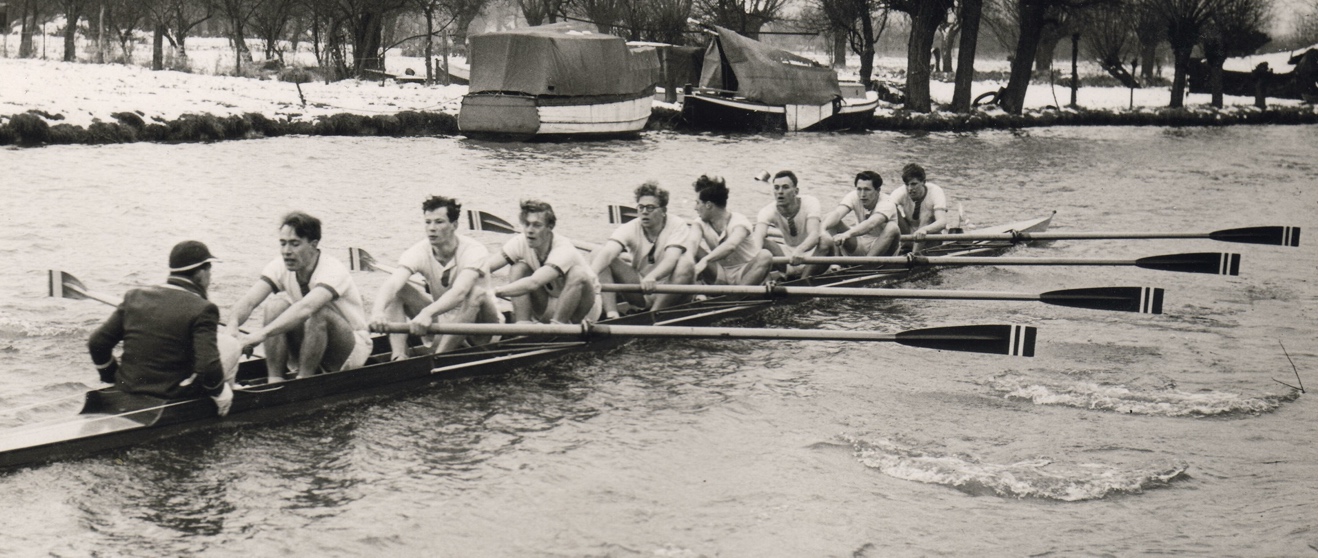
Our ‘55 Lents crew in hot pursuit.
Phelps, Leach, Oxley, Metcalf, Smith, Ironside, Poolman, Gear, Longley.
Howard at stroke, coiled, cool and competent as ever, rowing a captain’s blade and setting the pace; the apprentice behind him finally learning how to row, as promised by Danny, and no longer fascinated by that blue and white thing at the end of his oar.
But I ramble.
For the Mays, Martin Bartlett, younger brother of John, took over the stroke seat with brother John behind him at 7. Martin was an immaculate and strong oar, he brought a lot to the table. I was shuffled back the other side of the boat, to 6. Behind me – Smith, Metcalf, Gear, John Ironside and Geoff Poolman. Christopher Phelps coxed.
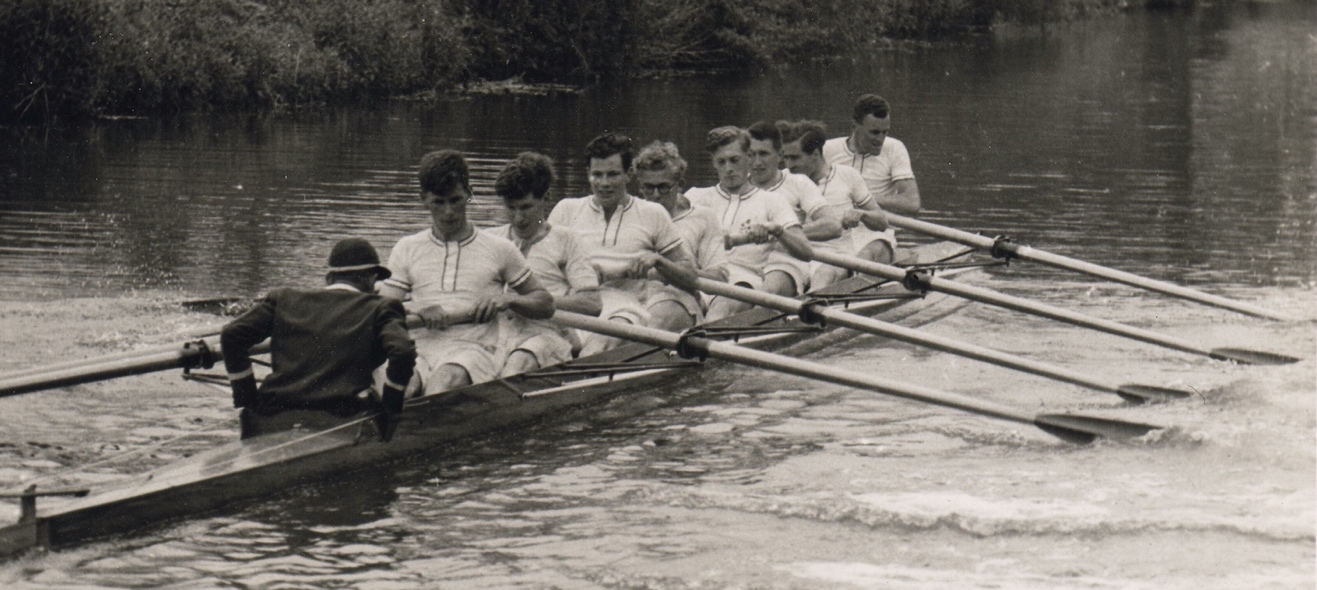
Coached by Danny, Howard, and Jack Biddulph from the pre-war era, we began as sandwich boat and, despite growing confidence in ourselves, were bumped by Magdalene. We would encounter them a year later, but of course didn’t know that then
With our equanimity somewhat disturbed, we set off for Henley. Three crew changes – Gordon Hewlett (Paul’s younger brother and now in his first year) replaced John Bartlett at 7; Robert van Hoeken (another new face in the 1st boat) replaced Bill Gear at 3 and David Longley replaced Geoff Poolman at bow.
We had the great good fortune to be coached briefly by Charles Rew, of London Rowing Club. Charles was an impressive character in many ways. I remember he took us into Leander and showed us pictures of great oarsmen of the past. That rowing virus was driven deeper into our souls.
Unfortunately, Charles would brook no nonsense when we complained of a balance problem which we thought had to do with the oars when in the water. In effect, he said “a good workman doesn’t blame his tools.” Coming to partial terms with balance, we beat Magdalen, Oxford by three lengths, but lost to Maggie (LMBC). At least we had gained racing experience, but again our confidence had been shaken.
And those cold showers! A row of open ended pipes over duck boards. Gordon reminds me that we would challenge each other to see who could stay under longest. We were sure the water was drawn from a nest of subterranean icebergs. One way of showering was to crouch ten yards away, do a sprint start and run straight through without stopping. Some days that was all the punishment your body could take!
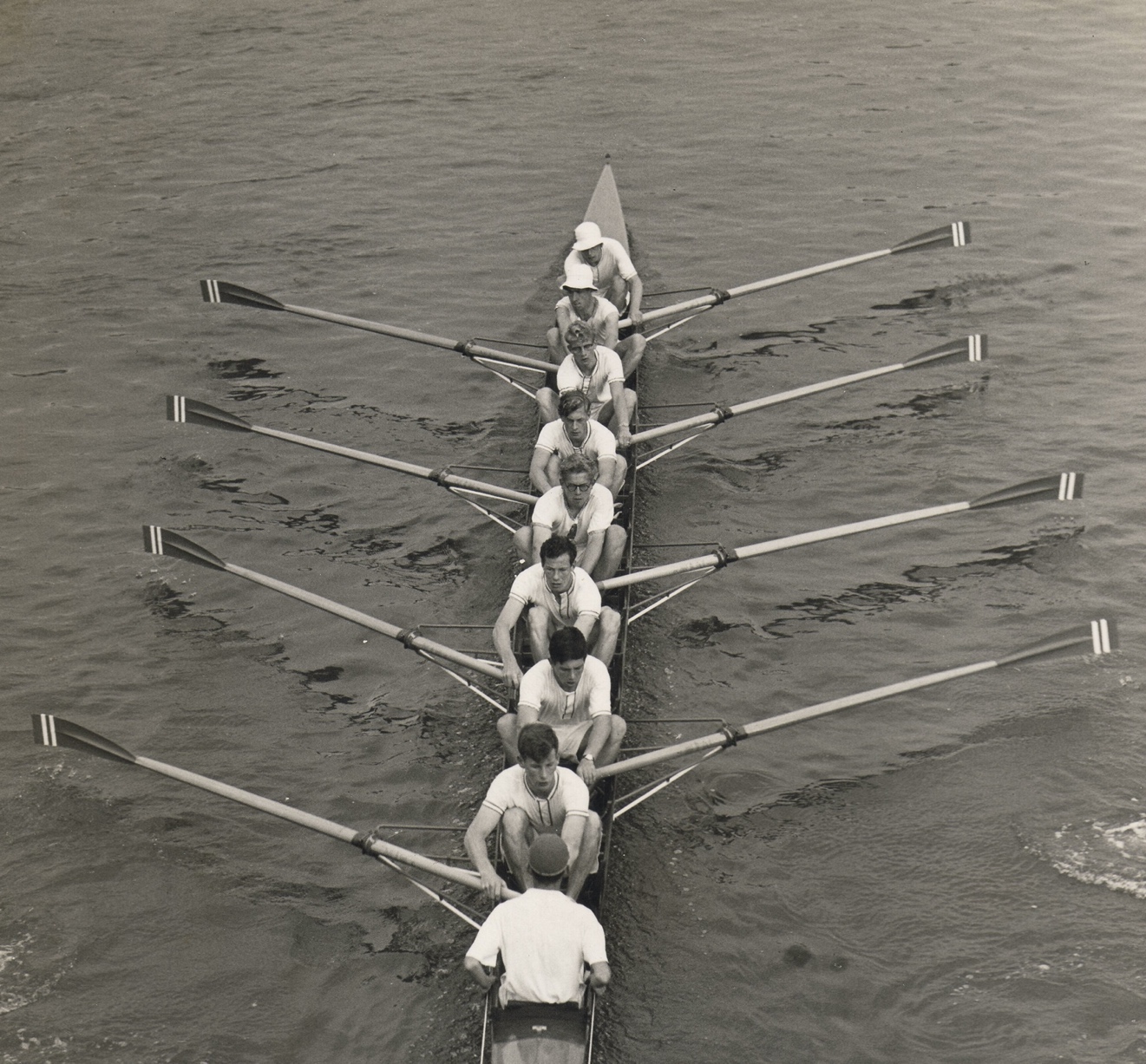
Henley ‘55
Phelps, Bartlett, Hewlett, Oxley, Smith, Metcalf, van Hoeken, Ironside, Longley.
We had been right about the oars. Brand new from Aylings and delivered to Henley, all eight of them were stroke side! I leave it the reader to imagine the gyrations, mental and physical, needed to prevent stroke side from washing out and bow side from getting stuck! How the heck we won a race, I’ll never know. We certainly didn’t feel like a crew destined for success.
……………………………………….
In the Long Vac term that year, a few of us were in residence for some additional studying, and we were able to put together a clinker four. I’ll never forget that first outing, when the habituated contortions we’d used to keep the VIII level at Henley, now applied to normal oars, created the reverse effect. But that turned out to be so valuable to us. We had to concentrate on essentials until the boat was as steady as a raft and balanced at all times. We were fortunate that Martin Bartlett was also in residence that summer. He was able to spend time in the bank with us, and coached us in the Radley style – the purest of Fairbairn. He refined our previously somewhat heavy-handed approach to beginnings, teaching us to take a quick, full-bladed grip on the water without loss of slide. We began to go faster and enjoyed a couple of local regattas.
The first order of business for the Michaelmas term of 1955 was an entry to the University IVs. Still not sure of ourselves, we entered the clinker division.
A clue that we might be doing something right, came one sunny afternoon in Long Reach. Behind us came Jesus’ 1st fine coxless four. It quickly became apparent that they wanted to get to Ditton before us – their rating went up a touch. Now a moment’s digression, if I may ... Danny had told us a lovely story about rowing in a combined Northern and Southern Irish IV in the ‘48 post-war Olympics. Apparently these boyos had been concentrating on a strong finish with a buried blade. During one training session they had found themselves alongside a hotshot IV from another country and destroyed them, by dropping their rating but beefing up their finishes. So … naturally, when Jesus upped their rating, we dropped ours and held them. They put their rating up again … and we dropped ours. By Ditton they were still alongside, at approaching a flat out row, while we, so it seemed to them I’m sure, were just coasting – in a clinker, and lugging a cox along too!
Pancake Day came soon thereafter. At a party in Jesus, amid flying pancakes, the Jesus Captain, Southgate, came up to me and asked “Brian, were you in that bloody ridiculous clinker IV the other day?” When I confessed, he asked me why we weren’t rowing a shell, to which I said that we still weren’t all that sure of our balance. He just snorted!
On our way to winning the University coxed fours, we beat Kings, Queens B, 1st and 3rd, Queens A and Lady Margaret – our first win since 1900.
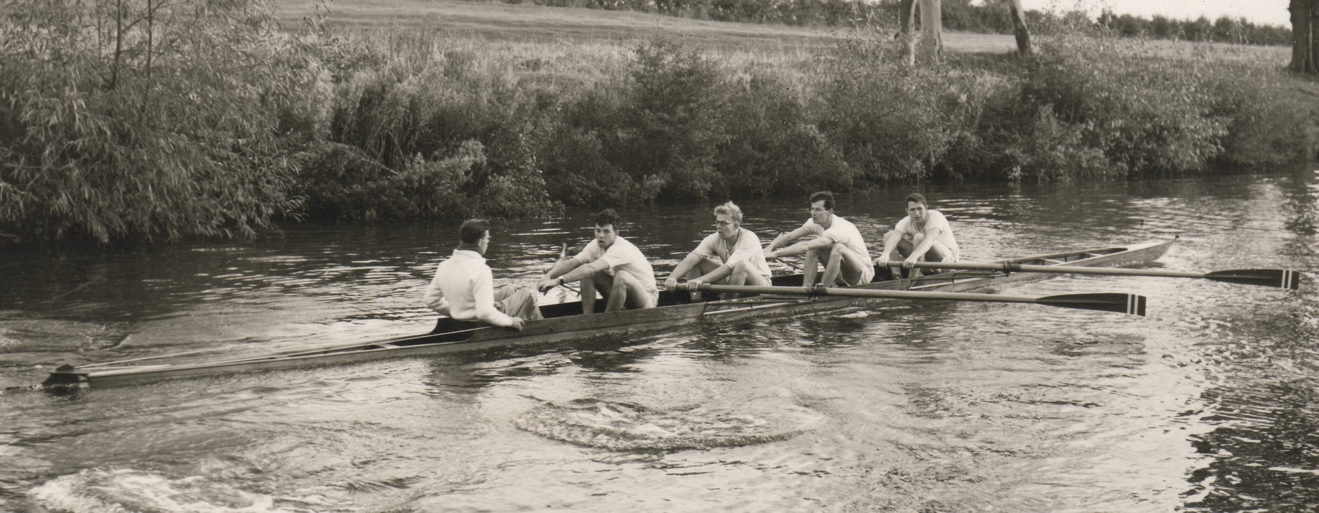
David Bright coxing, while Gordon Hewlett, Mike Smith, Brian Oxley and Bill Gear relax over the oars during one of the races – Gordon even posing for the camera.
“Jackie” was an older boat – open to the weather at bow and stern, but slim and fast. I’ve no idea who Jackie had been – lost in the mists of time even then.
Now at last we had a bit of confidence, and certainly confidence in our stroke, who would become arguably the most successful in P.B.C. history.
Putting together an VIII for the Fairbairn, Bill moved up to 7 with Mike in the engine room at 5. Ted Jackson came in at 4, Robert van Hoeken at 3, Ian Dodds at 2 and David Harper at bow. The solidity of that stern IV meant that we had no teething problems; bow IV settled right in during our first outing, to Clayhithe.
So why, when we set out to row the Fairbairn, were Ernie’s quiet words so important? Well, putting it simply, they gave us that added impetus, we won and thereafter we were sure of ourselves – no more crises of confidence. Not only did we know we could win, we darn well weren’t going to let anyone beat us!
………………………………………..
The Lent term saw us adding mileage and speed, with Martin Bartlett in at 7. Ian Dodds left us to spend more time on aeronautical engineering or some such nonsense. During that term we took a toughening trip to Ely and back, in two days I hasten to add. Can’t remember who it was who couldn’t make it, but someone couldn’t so I persuaded Dodds to fill the vacant seat. Ian has never forgiven me, or so he says. Imagine! You’ve not been in a boat since whenever, and have probably indulged in all kinds of ways in the meantime – and suddenly you have to row, what is it, 70 miles? And what a trip! The river below Bottisham was flooded, so much so that its whereabouts wasn’t obvious. At one point we stopped to debate the matter. Phelps was as usual decisive and said “I think it’s over there towards that low hill, so if we go through that gate we should be alright.” Fortunately the gate was open and bow didn’t have to get out. Eventually we found Ely.
We worked hard at getting our Little Bridge to Red Grind time down, to under 4 minutes if memory serves aright (mysterious men with stopwatches would appear sometimes). Part of the trick was to round Grassy Corner without using the rudder, by coming into it with bow side, particularly bow and 3, reaching out to lengthen their stroke while stroke side shortened up without letting up on effort. The result was that the boat swept around the corner without loss of speed. An immediate ten out of the corner had us leaping up Plough Reach, to the dismay of anyone in front of us. David Harper used to complain that the bow rode up so high during that ten that he had difficulty reaching the water! For him, the sound of bubbling under the hull was his clue that we were planing. He enjoyed the feeling, so sometimes we’d find our bow pair leading us into a smarter clip, stroke and the rest of us going along for the ride. Not quite sure how that worked, ‘cos timing stayed perfect – maybe it was telepathy.
There was one other memorable incident during that term, for me at any rate. I was coaching the 2nd boat on a pleasant sunny afternoon. On the way back upstream, coming round Ditton, I was opposite the bow, watching the bobble to see if there was any checking. Actually, there wasn’t, so their sliding was smooth and their beginnings were O.K. Into my focused field suddenly sprang a light blue bobble, approaching our darker blue one at high speed. Both coxes reacted instantly – blades holding hard – and the bobbles came to quivering rest, overlapping with no damage. When the foam had subsided there was silence, except for a strange clicking sound. I looked up to see a gang of pink and blue caps clicking their stopwatches. The Blue Boat on a full course trial!
We should have been on the other side of the river! That evening Bill Masser of TrinityHall, CUBC President, knocked on the door of H6. He had come to apologise, as they hadn’t posted the time of the trial. I met Bill again after the Lents when we found ourselves cycling together on the towpath. He was concerned that he wouldn’t be able to propose our crew for membership of Leander, explaining that there was no precedent for basing such on the Lents Headship and we were a whole division down in the Mays. Actually, the thought hadn’t entered my mind. Seeking to reassure him, I said “Don’t worry, Bill, we’ll be going to Henley.” He asked what event. I told him it would be the Ladies and he said “Oh – we’ll be in that, too.”
Briefly back to the Lents. On the first day Maggie escaped by bumping 1st and 3rd, but we were already breathing down their necks when that happened. 1st and 3rd took us to the Glasshouses on the Thursday and Maggie held on to the Railings on the Friday, leaving us only Jesus to catch.
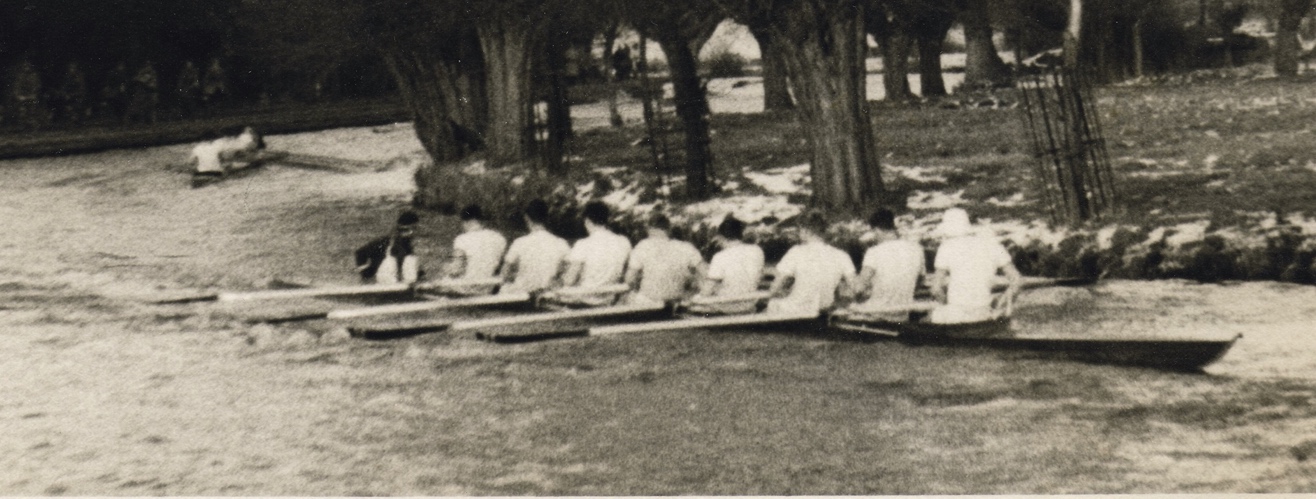
Coming out of Grassy on the Friday, – bows beginning to lift.
1st and 3rd well behind us. Maggie’s puddles frothing alongside our bow.
Now folks were sitting up and taking notice, even the Times. Jesus gave us a good race but by the Red Grind we were closing. A ten out of Ditton finished the job.
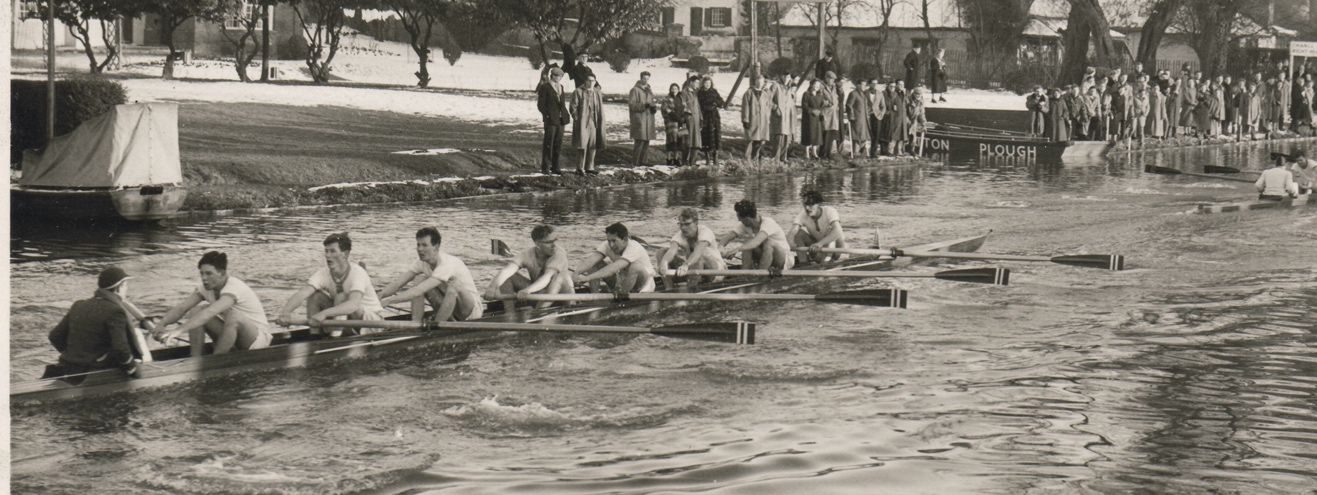
Chasing Jesus in Plough Reach – bows riding high and looking hungry.
Phelps, Hewlett, Bartlett, Oxley, Smith, Gear, van Hoeken, Jackson and Harper.
The Bump supper was a rather subdued affair, at first. Gordon remembers that we couldn’t really believe what we had done – like Abrahams in Chariots of Fire, when he’d won his gold medal and needed to be left alone. The C.U.W.B.C. had an old shell to dispose of, the Black Prince, and sold it to us for five quid. I still have the receipt and Gordon has a bit of charred remnant. I don’t know how on earth the bonfire came to be built on Coe fen – it appeared while we were having supper. At the gate behind the Birdwood, the Dean was handing out weak beer and old doors. Gordon and Ted found time go to Complin at 10 p.m. appearing in Chapel in Boat Club blazers, to the surprise of Chaplain Charles Walker – but he was a staunch supporter of P.B.C., as was the Master, of course. The fire was still smouldering two days later.
The Times on the Monday exclaimed:
“PETERHOUSE GO HEAD. WELL-EARNED TRIUMPH AT THE LENTS.
It may be unkind to Jesus to say that oarsmen from all over the country, and perhaps from even farther afield, were waiting to see whether Peterhouse could catch them in the Cambridge Lent races on Saturday. But they are, no doubt, sufficiently magnanimous – as they can well afford to be – to congratulate their conquerors on a resounding success, particularly since Peterhouse owe so much to Steve Fairbairn the genius of Jesus.
Only once before, in 1842, when the Lents and Mays were but two sessions of the same series of races, have Peterhouse finished at the head of the river. To have done so after bumping Lady Margaret, First and Third, and Jesus, on consecutive nights, was a triumph indeed. It was well deserved, for although by no means a polished crew, they displayed great determination. They seemed to be slow starters, but, on each occasion, after reaching the Gut they closed up rapidly, and went on attacking until the bumps were made.”
He knew whereof he spoke, and must have been down at the start at least once!
But “by no means a polished crew?” Steve would have laughed and said “… but how fast were they?”
The heart-warming reaction from Petreans was reward in itself - but my it was fun!
The term wasn’t over, though, and nor was the fun. We hadn’t sat in the shell since that strange trip to Henley the year before; now it was time to go to Reading. It still felt strange somehow and this time it couldn’t be the oars. Knowing enough to trust our feelings, we sought the answer. Was it still to do with the angle of the blades? Basil Rennie, a member from the early 50s, rode alongside us one day. Afterwards we talked and he wrote to me suggesting adjustable rowlocks, enclosing ten quid to buy them! Then Ernie put his finger on it – the runners under our seats were horizontal, with no slight rise to the finish. It was a fine point, but absence of any rise at the finish left one with a feeling of being buried in the boat, with no free downhill glide back to the gather. So Ernie cut some long thin wedges and put them under the runner beds. That worked a treat and all felt right again.
The second boat came to Reading with us, entered in the clinker division. I’ve no record of how they did. We started out in 14th spot and finished 3rd, beating such crews as the Royal Air Force (a strong club in those days) and London University. Thames, the defenders, won again. Jesus almost won but came second. Thames 16:16, Jesus 16:18; Pothouse 16:28. Mind you, we had traffic … somewhat hectic as crews started at 10 second intervals, - but no excuses! Thames won the Tideway head that year, too.
We then set off to row to Putney. I seem to think we did it in two days, but it’s all a bit of a blur now – except for the bend around Windsor Great Park and our singing “It’s the same the whole world over – it’s the same wherever you go – it’s the rich wot gets the credit - it’s poor wot gets the blame – ain’t it all a bleeding shame!” Not that we were attempting any kind of political statement – it was just that the rhythm fitted our by now somewhat lethargic stride. And I remember Teddington tideway lock, in which Christopher had us do a start and ten, with room to spare.
Climbing wearily out of the boat on the hard at London R.C., I lifted my head to see Bill Masser standing there. He commented that we’d done rather well at Reading and asked would we mind coming out to pace the Blue Boat!!!! I think I said something along the lines of being a bit tired, but would be happy to oblige the following day, when we held them for 2-3 minutes but then their cox had a good line on where the stream was.
We hadn’t entered Putney, unfortunately, so that was it and we headed home. Thames won the Tideway Head and Cambridge won the Boat Race.
The May term was a time for consolidation – and there were exams looming. Paul Metcalf rejoined the crew at 2 and Ted Jackson moved up to 4 to replace Bill Gear. David Bright took over the coxing task from Christopher Phelps. We enjoyed our outings and our boat teas. Fitzbillies malt loaf and Chelsea buns were a staple in our diet. In Hall, the waiters kept us provided with extra spuds and we enjoyed the occasional stoup of ale with dinner - the college silver was still in daily use back then. There was no bar in college.
The bumps went as well as could be expected. I don’t think we had to go round First Post Corner, but if we did, it wasn’t far. We bumped Caius, Cath’s, King’s, Maggie II and 1st and 3rd II. While we were doing that, Magdalene, ahead of us and separated by one boat, were also winning their oars.
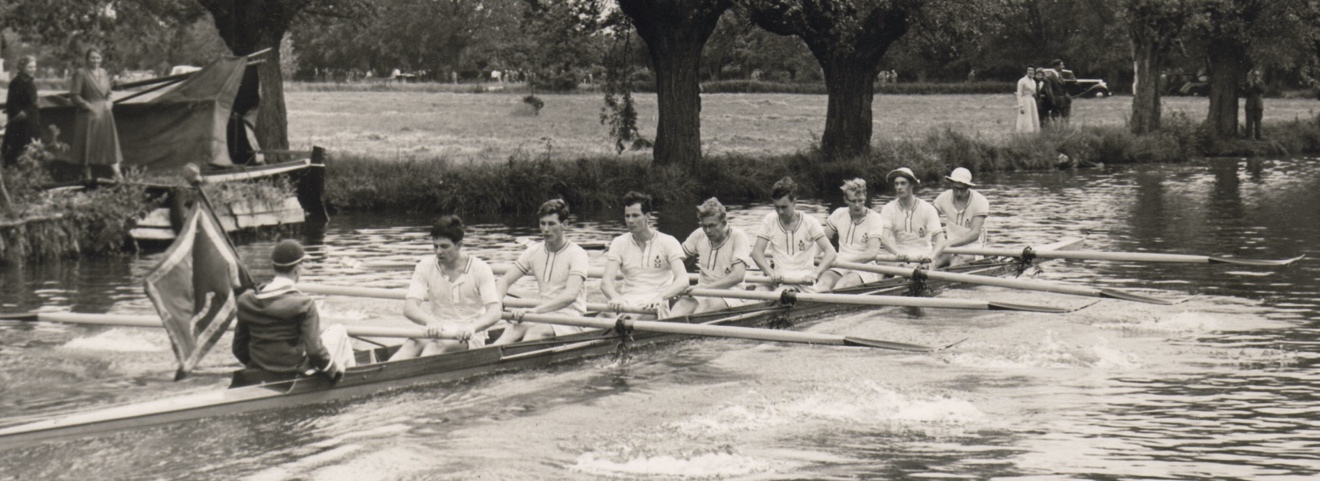
Mays ‘56
Bright, Hewlett, Bartlett, Oxley, Smith, Jackson, van Hoeken, Metcalf, Harper.
One more memorable moment. It was after the Mays, and the exams were over. The 2nd boat (I think) wanted an outing and I rode alongside enjoying a sunny afternoon. Heading down below Chesterton into Long Reach, the boat was towards the other side of the river, when along came a big cruiser dragging a huge wash behind it. Powerless, I could only watch as the waves reached our boat. The first two lifted it by bow and stern, so high that I could see the far bank UNDER the boat – a rare sight indeed! Totally swamped, they made it to the bank to empty out.
Oh yes, mustn’t forget the P.B.C.Fund. Nick Kaye and I had talked about setting up a fund to buy boats and I’d arranged to meet Nick for lunch at his club in London. Ted Jackson kindly volunteered to drive me up to town. His car was an open-topped, two-seater 1932 Morris 8. We set off merrily for London one fine morning and enjoyed the trip, except for a rather large truck from which we could escape on uphills, being so light, but which came hurtling down behind us on every downhill, looming very large. Eventually it turned off elsewhere. Approaching London, Ted instructed me in the use of the handbrake; after all, we might encounter a traffic light! If called upon, I was to heave mightily. On closer inspection I saw that this vital equipment wasn’t connected to the wheels in any way, being simply a single lever – my heaving would cause it to drag against the road, rather like pulling up a luge in the finishing straight. Ted, however, was competent in all he did, so I had faith.
…………………………………………………….
Tom Askwith had leave from Kenya, or the Staff College - don’t remember which - so was able to take us after the Mays. He was of course courteous and uncritical – after all, it was too late to change much! But, as ever, his mere presence on the bank was enough to stiffen the back and add inches to every stroke. His advice was avidly embraced. This was God speaking, as far as we were concerned.
Marlow revealed that we had a problem with our start. Against the National Dock Labour Board, all we did was generate a cloud of spray off the start and never got back into it. So that was Marlow! Magdalene moved on to the final and won – clearly a force to be reckoned with.
Back on the Henley reach, Tom set about correcting our start, with some success - enough to make us at least respectable. That was demonstrated the day Charles Rew, our coach from the year before, asked us to join his London crew, entered in the Grand, down at the start for a bit of a short contest. Suitably lined up and thinking ahead to when we would be doing this in earnest, we took off well and quickly established a lead. When we easied at the Barrier, it was to hear Charles say in a rather gruff voice “Well done, Peterhouse. London … go back and do it again.” We felt for London, but were somewhat reassured. (Charles’ crew reached the semi-finals in the Grand, losing to a Swedish entry after leading them at the Barrier and Fawley.)
One other incident in that week – Mike Smith became the only member of our crew to see us in action. A back problem put him onto the bank. Our listed subs were Mike Frost, Mike Herten, Bill Gear and Danny. Mike Frost stepped into the breach and has a photo to prove it. Mike Smith was decent enough to tell us he was impressed by what he saw. He was out of the boat for only one day. Tom found someone in Leander to lay him on a bench and jump on him or something, which miraculously worked.
At Henley, just as with any event not taking place on your home water, you really don’t know what you’re going to be up against. At home one has a fair idea of the opposition’s capabilities, but not so elsewhere, and certainly not at Henley. Out for a walk on the towpath one day, we saw Trinity Dublin at work. They would be our first opponents the following Wednesday. We were impressed by their apparent strength and skill (dare I say polish?), and not a little worried!
That weekend we took a long walk, as advised by Tom – a very long walk.
On the Wednesday we went to the start to race that competent looking Dublin crew, but our bow’s blade broke entering the station. Regatta officials ordered a postponement, so we had to wait all day – what suspense! To our surprise, we finished four lengths up!
On the Thursday we beat Emmanuel by a length, but they gave us a fright. They were a heavy crew and hammered into the stormy conditions very well. It seemed as though we lost our concentration, worrying as to why they didn’t just fade away. That evening, up on Western Road for our evening stroll, we talked about needing to think harder about our own rowing.
The Friday saw us pitted against Trinity Hall, a crew containing three of that year’s winning Blue Boat and a trial cap. We won by 1¼ lengths, much to the surprise of the cognoscenti. The crowd seemed a bit quiet as we came happily home.

So on to the Saturday … ah yes, THE Saturday! First imagine yourself going down to the river, to those huge marquees where all the boats are stored, to find yours is the only one in sight – a salutary reminder that now there’s a lot at stake – and Magdalene, winners at Marlowe, had a Friday Fawley time only one second slower than ours.
Lining up for the start, I looked back at the Enchantress (or was it the Magician?) – that beautiful launch that carries the umpire and privileged guests in comfort while you slog it out. There was Tom, in Leander blazer and light blue cap, looking as worried as a man could be – he had a lot riding on this one, too! I called out “Have a good row, Tom!” and the smile that broke over his face was worth every cup there is.
Off the start, Magdalene moved ahead and their cox began to call out his relative position in an effort to encourage his crew and demoralize us, “I’ve got stroke. I want seven!” “I’ve got seven, I want six!” “I’ve got six, I want five.” That was as far as he got – our Red Grind sessions were paying off. Then there was a long silence …………….
When he eventually called “I’ve got seven, I want six” in an unconvincing way, his encourage/demoralize strategy was clearly backfiring.
We were up a few feet at Fawley and half a length at the mile post (Times report) - well in control but still having to work hard. Passing the enclosures and the Phyllis Court wall, a freak gust of wind bent the tops of the trees on the Berkshire side. Our cox, Pilot Officer David Bright, yes he was a real pilot, was experienced in such matters. He anticipated the effect the wind would have and turned towards the gust. Nevertheless, when it hit, we were swept willy-nilly onto the booms. Martin, at 7, had to drive his blade deep into the water, taking a stroke under the boom. Magdalene didn’t have so severe a problem, blown across as we were but at least in open water.
We fought back onto the course, hanging onto enough of our earlier lead to win.
The finish photo doesn’t convey any of the drama, although the top of that poplar tree is still bending.
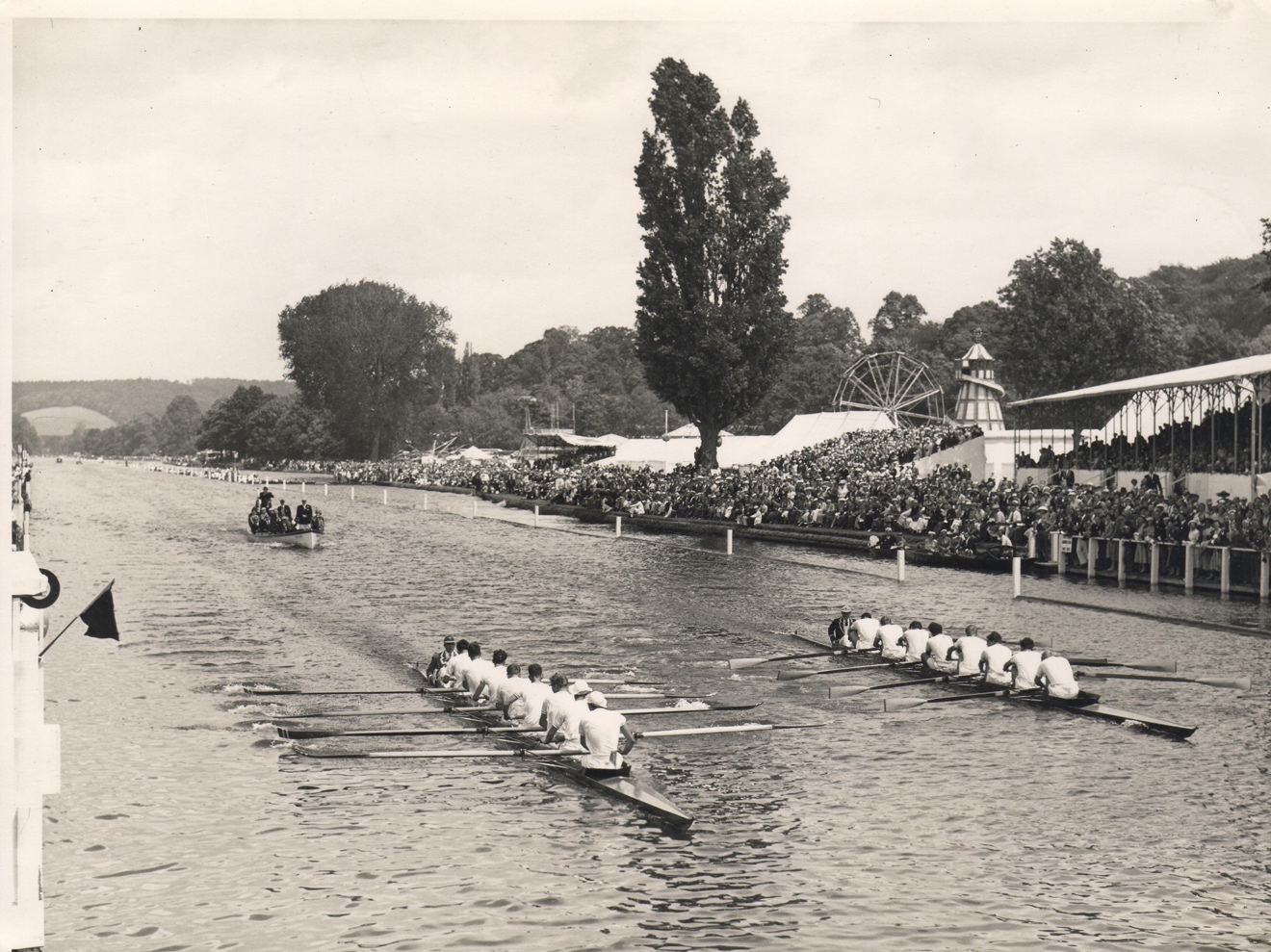 (Have to feel for Magdalene, though. They were an excellent crew, and
fast.)
(Have to feel for Magdalene, though. They were an excellent crew, and
fast.)
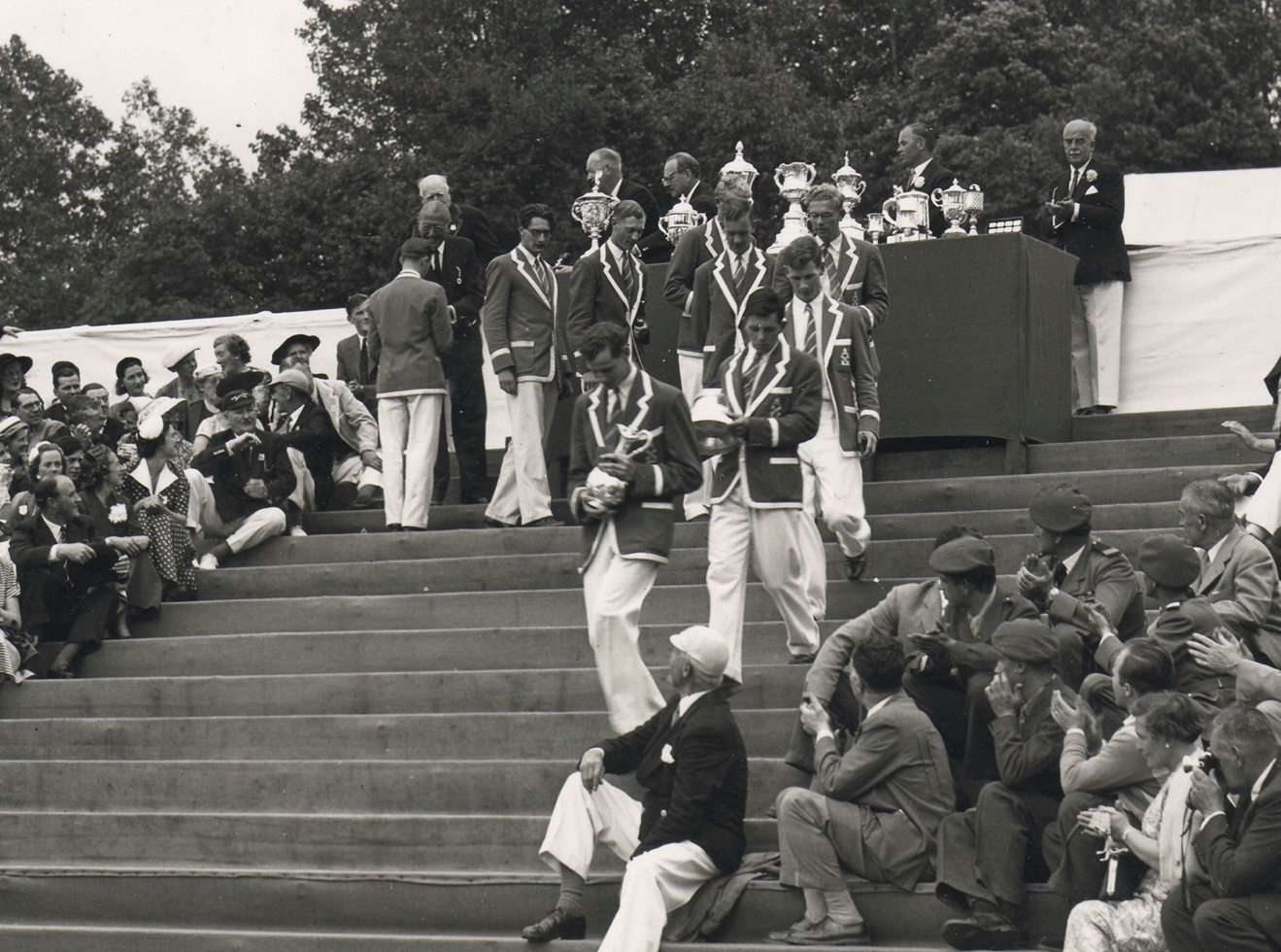
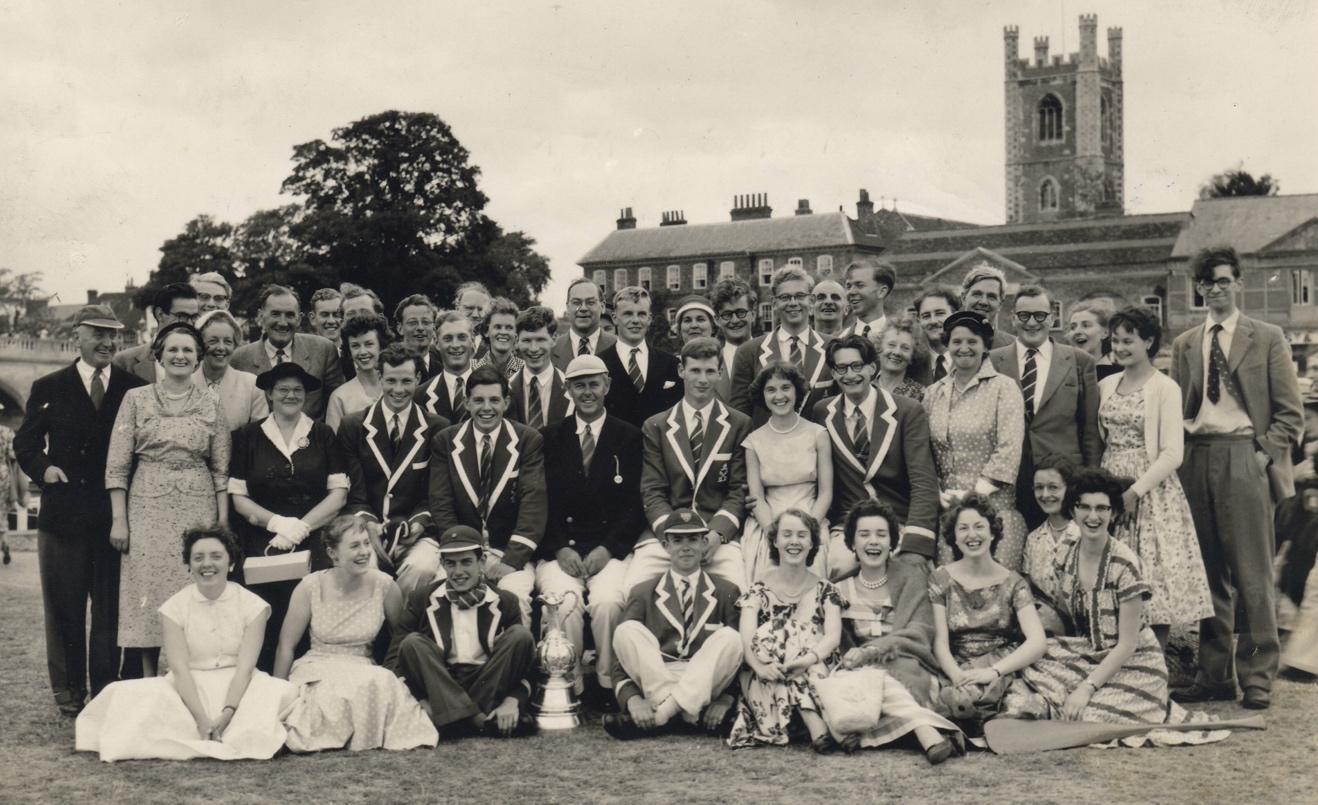
I can’t identify some of the faces in this happy group, but see Ernie in his usual position and pose, Mrs. Coplestone and her daughters Mary and Jennie, our hosts the Hammonds, Peter Sutherby (I think), Nick Kaye, Pat Askwith, John Bartlett, Jack Biddulph, Donald Hood, Tim Voelker, Mike Frost, Peter Toulman (I think), the Hewlett parents, … and of course the crew and Tom, with the Ladies Plate nestling between our two super coxes, Christopher and David. Other Petreans were surely there in spirit!
The Sunday Times of July 8th 1956 carried the following:
GRAND GOES TO GREAT FRENCH ARMY CREW #
By Sir Herbert Thompson
Henley was storm-ridden to the last, and though the conditions for the finals of the regatta yesterday did not reach the freakish violence of Thursday’s gales, they were neither the proverbial Henley nor good rowing weather. But nobody could complain that the racing was not exciting.
The Grand proved that there was only one really great crew, the French Army eight …
… It is good that when for the first time the Grand Challenge cup goes to France, such a crew should take it there.
Homeric Battle.
The Ladies final was an all Cambridge affair which showed the way new blood is counting, for in a tremendous race, Peterhouse just beat Magdalene by a quarter length. They were the outstanding crews of the event, but neither college had ever won it before.
So – “A rough crew but fast?” Back to my question …"[How fast]{.underline}?”
Suffice to say that our best Fawley time that week was faster than that of any other crew, including the French Army; and our best final time, against Trinity Hall, was beaten only by the French Army.
……………………………..
1956 was an Olympic year. The captain of our British crew, on his return to England, wrote to the rowing press to suggest that the method of selection should be reconsidered. He urged that instead of picking individuals, the fastest crew in the country should be sent. Then he stated firmly “and this year it would have been Peterhouse.”
……………………………..
The Daily Telegraph of December 5th announced:
3 PETERHOUSE MEN IN TRIAL. CAMBRIDGE PLANS.
Three Peterhouse men, members of the fastest Cambridge crew seen at Henley last July, will be rowing in the Cambridge Trial Eights race at Ely on Saturday. They are R.van Hoeken, A.M.Smith, and M.H.Bartlett, who were at 3, 5, and 7 at Henley.
Martin went on to row in the winning crew. Robert van Hoeken was spare man and Mike Smith garnered a trial cap.
…………………………………………..
I have set the foregoing ramblings on record for two reasons.
Firstly, if I don’t the story will be lost for ever.
Secondly, and most importantly, [most importantly]{.underline} … we, the lucky twelve who occupied various seats in Peterhouse First Boats during the year 55/56, owe an enormous debt of gratitude to all who went before us. To you crews, captains and coaches who set the scene in PBC, and showed us how to win and how to train – thank you! These were as much your victories as ours.
‘Nuff said! Brian
…………………………
[Footnote:]{.underline}
P.B.C. has enjoyed several periods of success since ‘56, and a great many worthy individuals, notable at university, national, and even international levels, have been Petreans. I like to think that something about that wonderful boathouse of ours, some subliminal aura of excitement perhaps, may have penetrated their minds.
One thing’s for sure – the camaraderie that grows from plying a Peterhouse blade in the waters of the Cam extends from generation to generation, unbroken. Roland Mayer said it well – “… continuity of fellowship which obliterates the years.”
P.L.Hooson, who had been PBC’s Hon. Sec. in 1892, corresponded and came to our celebratory supper on Nov. 10th ‘56. He could conceivably have known older men who had been youngsters when our club began - who knows?
H.A.Sams, (1894 – 1897 and who penned the foreword to the 1935 reprint of T.A.Walker’s “Peterhouse”) wrote to congratulate and asked me to give his regards to Tom. He regretted that John Payne had not lived to see our successes. (J.E.Payne – winning blue boats of 1899 and 1900, ending a run of nine Oxford successes.)
J.E.T Brown – “May an old P.B.C. man – 1935 vintage – send you his congratulations on winning the Ladies? Splendid bit of work. I have followed your achievements in the last year or two with great interest and growing enthusiasm, and this is a fine climax. You see, one’s feelings for the P.B.C. don’t wane.”
D.Vernon Tomson, who told me there were only two other people of his year (1902) who were still alive, finished his last letter with “I can only end by saying how very grateful I am to you for affording us such intense joy.”
……… THE END ………
Additional notes (appendices):
Tom’s closing thoughts.
Reassurance – “mens sana in corpore sano” - in other words, rowing doesn’t turn your brains to mush – after all, it didn’t hurt Kelvin! So what happened to those 12 guys afterwards?
More memories.
Club spirit – the Mitchell Cup, Rugger Boats and such matters.
Reaching even further back.
About Captaincy and how our smallest college still has a chance, even given today’s challenges.
Maybe this last one ought to be the prime document, written by others, to which the “story” is attached as an appendix. The future is the important thing, after all.
How do we ensure that future members are motivated? Will they instinctively understand that if they want to remember their P.B.C. days with pleasure, they had best put something into it – get fit and strong to row in a determined and competent way?
In slack times there have been threats to PBC’s wonderful continuity.
Once it was suggested that the boathouse would make a great restaurant. It would, of course, but where would you park?
Amalgamation with another college, if you can believe it? No way!
It is a shame that our boathouse is not reserved exclusively for Peterhouse use. Can we make that happen?
For as long as rowing is a part of the Cambridge scene, then Peterhouse, reaching back before the first Boat Race, with 1828 and our crest prominently displayed on our jewel of a boathouse, must be a part of it.
Once the club was at such a low ebb that the Master, Paul Velacott, urged everyone to row. There was also a year in the early 1800s when every one of Peterhouse’s 19 undergraduates rowed – the spare man carried the flag (Walker’s history). We must ensure that whatever happens, whatever swings in enthusiasm, the club lives on to rise again.
It is to be hoped that men and women joining PBC in the future will always know that they are becoming part of a fun story, and do their best to keep it going.